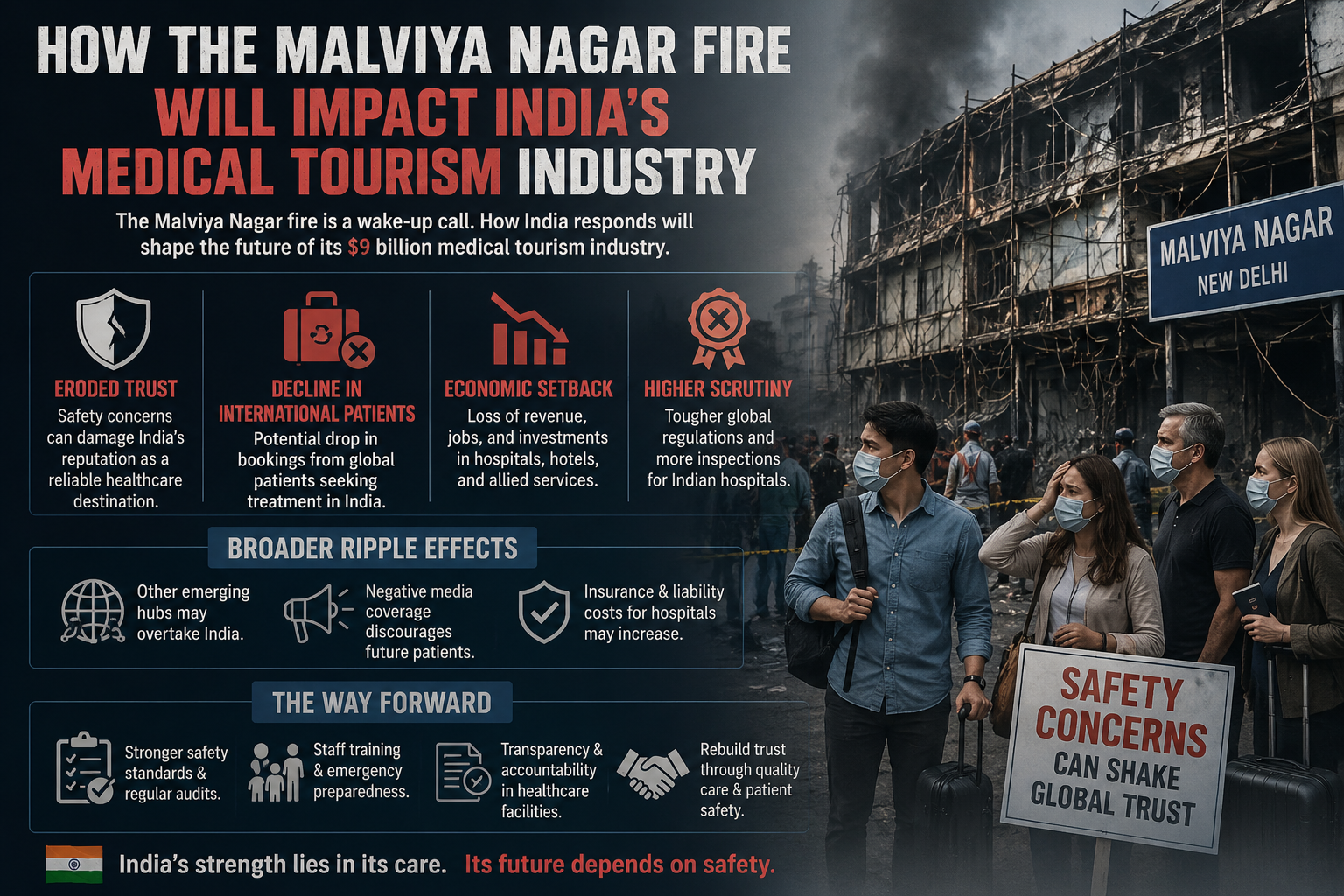

When a fire tears through a building full of foreign nationals who traveled thousands of miles to sit beside a sick parent or spouse, it does not just claim lives. It damages trust. And in the medical tourism business, trust is everything.
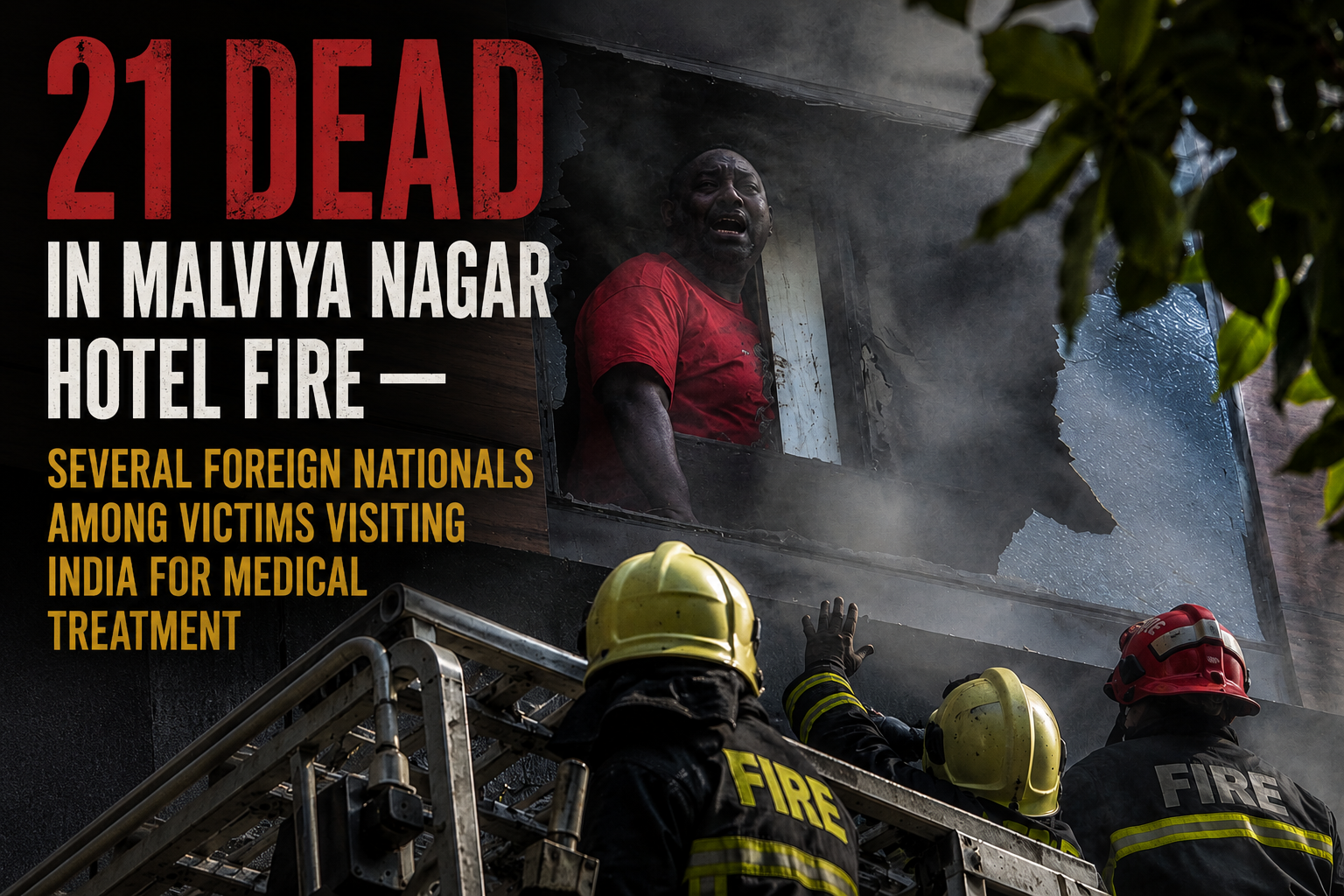
Today's fire at Flourish Stay B&B in Malviya Nagar, which killed at least 21 people — many of them international patient attendants from Central Asia and Africa staying near Max Super Speciality Hospital, Saket — will reverberate far beyond the charred walls of one illegal guesthouse in South Delhi.
Here is a clear-eyed assessment of what this tragedy means for India's $9 billion medical tourism industry.
1. Immediate Reputational Damage — Especially in Africa and Central Asia
India's medical tourism market is heavily concentrated among patients from East Africa (Kenya, Tanzania, Uganda, Ethiopia), West Africa (Nigeria, Ghana), and Central Asia (Uzbekistan, Kazakhstan, Tajikistan, Turkmenistan). These are precisely the communities that lost people today.
Most of the foreigners who died were from Central Asia and Africa and were family members of those undergoing treatment at the nearby Max Hospital.
Word travels fast in tight-knit patient communities. A family in Nairobi that loses a relative in a Delhi hotel fire does not just stop traveling to India — they tell everyone they know. Community WhatsApp groups, Facebook groups for Nigerian medical travelers, Uzbek patient forums — these are where India's medical tourism reputation is made or broken at the grassroots level.
The short-term impact will be felt most acutely in these source markets. Patients with upcoming trips may delay or reconsider. Families who were planning to accompany a patient may decide to stay home. This has a direct knock-on effect on Indian hospitals that depend heavily on African and Central Asian patient volumes.
2. The Accommodation Gap Is Now Impossible to Ignore
The multi-storey guest house in south Delhi's Malviya Nagar stood directly opposite a major hospital. Many of its occupants were not tourists or business travellers. They were relatives accompanying patients, attendants caring for loved ones and foreign visitors who had travelled to India for affordable medical treatment.
This perfectly describes a systemic gap that the medical tourism industry has long papered over: there is no regulated, verified, safety-inspected accommodation ecosystem for international patient families in India.
International patients and their families — often traveling on tight budgets — rely on cheap B&Bs, guesthouses, and informal stays near hospitals. These establishments are unregulated, frequently operating illegally, and in many cases are death traps. Preliminary investigations revealed that while Flourish Stay B&B held official tourism department approval to operate just six residential rooms, the owners had constructed and packed 24 rooms into the building, actively selling them to unsuspecting travelers via major online travel aggregators.
The fact that this hotel was listed on major online booking platforms makes this a systemic failure — not an isolated criminal act. International families trusted a platform, booked what appeared to be a legitimate stay, and paid with their lives.
3. Regulatory Crackdown Is Coming — and It Will Disrupt the Ecosystem
The government has already responded. The minister directed the setting up of a high-level committee to be headed by the district magistrate, comprising officials from the fire department, municipal corporation, and power, health and tourism departments, to inspect all lodging establishments in Delhi.
This inspection drive is necessary and overdue. But its immediate effect will be the closure or forced reduction of dozens — possibly hundreds — of budget guesthouses and B&Bs near Delhi's major hospitals. In the short term, this will create an acute accommodation shortage for international patient families at the exact moment demand for affordable stays near hospitals is highest.
Hospitals, medical tourism facilitators, and the tourism ministry will need to work urgently to fill this gap with verified, safe alternatives.
4. Online Travel Aggregators Fa ce Scrutiny
The heavily altered building offered only one single, narrow escape route and virtually no ventilation, with the building completely lacking the emergency exits required of a standard commercial hotel. Yet it was bookable online, with reviews, ratings, and a listed address.
Platforms like MakeMyTrip, OYO, Booking.com, and Airbnb that list budget accommodation in medical tourism zones around Indian hospitals will face pressure to verify fire safety compliance before listing. This is a conversation that is long overdue.
5. Max Hospital's Response Sets a Benchmark
It is worth noting that Max Super Speciality Hospital, Saket, immediately activated its mass casualty response protocol and mobilised all available clinical and support resources. Of the 39 patients received at Max Hospital, 18 were brought dead, 15 are admitted in ICU including 8 patients on ventilator and in critical condition, 5 patients with minor injuries were treated and discharged.
Max Hospital's swift, professional emergency response will be noted internationally and should be acknowledged. India's hospital infrastructure responded well. It was the accommodation infrastructure that failed.
6. The $13 Billion Question
India's medical tourism sector was estimated to be worth US$9 billion in 2022, with approximately 2 million patients visiting India each year from 78 countries, expected to reach $13 billion by 2026.
This growth trajectory is now at a critical juncture. India's competitive advantages — affordable surgery, world-class doctors, English-speaking staff, no waiting lists — remain intact. But a fire that kills international patient families in an illegal guesthouse next to a hospital sends a signal that India has not built the full ecosystem that serious medical tourism requires.
The countries competing for India's medical tourism patients — Thailand, Turkey, Malaysia, UAE — are watching. They invest heavily in verified, regulated, hospital-adjacent accommodation for international patients. India's budget advantage is irrelevant if a patient's family does not feel safe.
What Must Change: A Seven-Point Action Plan
1. Mandatory Hospital-Adjacent Accommodation Registry Every major hospital in Delhi, Mumbai, Chennai, Hyderabad, and Bengaluru should maintain and publish a verified list of safe, inspected accommodation for international patient families — updated quarterly.
2. Fire Safety Certification for Medical Tourism Zones All accommodation establishments within 3 km of major hospitals treating international patients must hold valid fire NOC, verified exit routes, and working sprinkler systems. This should be a condition of listing on any online platform.
3. Online Platform Compliance MakeMyTrip, OYO, Booking.com and similar platforms should be required by law to verify fire NOC before listing any property in a designated medical tourism zone.
4. Dedicated Safe Stays Programme The Ministry of Tourism's Heal in India initiative should fund a Verified Medical Stay programme — similar to hospital accreditation — specifically for guesthouses and B&Bs that serve international patients.
5. Patient Family Safety Briefing Medical tourism facilitators should provide every international patient with a mandatory accommodation safety briefing: what to check, what to avoid, red flags in budget stays.
6. Embassy Coordination Indian embassies in source countries (Kenya, Nigeria, Uzbekistan, Kazakhstan, Yemen, Bangladesh) should proactively communicate safe accommodation guidance to patients applying for medical visas.
7. Fast-Track Justice The owners of Flourish Stay B&B ran an illegal operation that killed 21 people. Fast, visible justice is necessary — not just for the victims, but to signal to every other unsafe guesthouse owner in Delhi that violations carry consequences.
The Bottom Line
India's medical infrastructure is world-class. Its accommodation ecosystem for international patient families is not. Today's fire at Malviya Nagar has made that gap undeniable.
The question is not whether India's medical tourism industry will survive this — it will. India's advantages are too strong, the demand too high. The question is whether the industry will use this tragedy to build something better, or wait for the next fire.
For the families of the 21 who died today — many of whom traveled to India full of hope, sitting beside a hospital bed waiting for good news — the least we can do is make sure it never happens again.
Sources: Republic World, Gulf News, The Statesman, Business Standard, The Week, Scroll.in — June 3, 2026
Tags: Malviya Nagar Fire, Medical Tourism India, India Hotel Fire, Patient Safety, Accommodation Safety, Flourish Stay B&B, Max Hospital Saket, Medical Tourism Impact, India Healthcare, Foreign Nationals Delhi
Comments (0)
No comments yet. Be the first to share your thoughts.